How did the Greek and Chinese deities save? How wide-ranging were their powers, and where did the limit of their influence lie? This virtual exhibition presents some of the most widely worshipped divine figures from Greek and Chinese polytheism who protected worshippers in various aspects of human life.
The Ancient Greek Gods
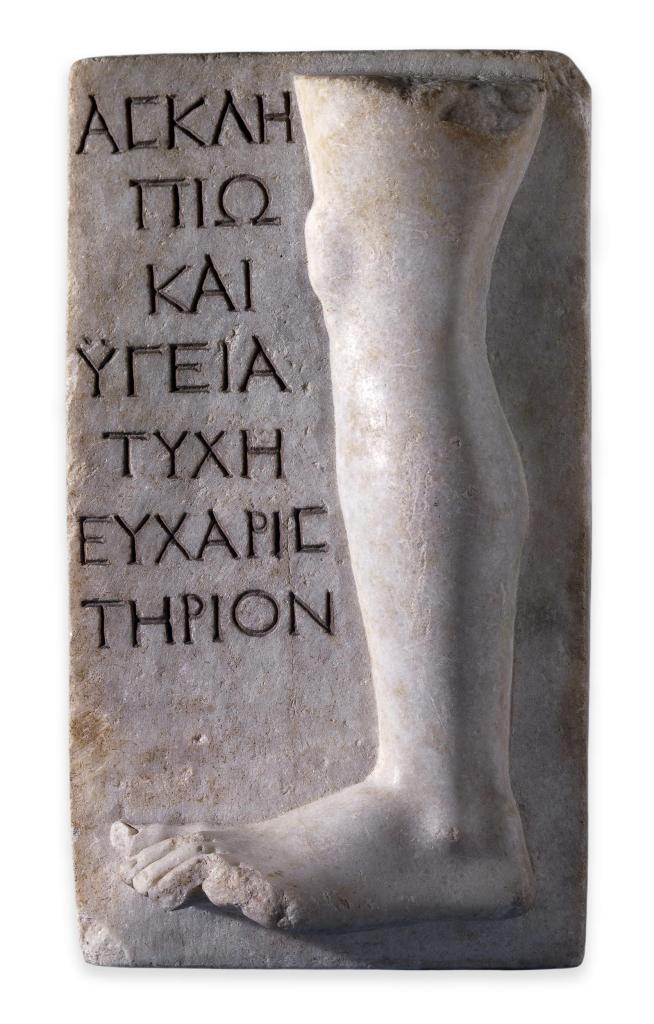
Asclepius
Mable relief depicting a left leg. 1st to 2nd century A.D., sanctuary of Asclepius on Melos.
British Museum 1867,0508.117. Shared under a CC BY-NC-SA 4.0 licence.
The supreme divine physician in Greece was Asclepius: he specialised in curing individuals of sickness and injuries, and enjoyed great popularity from the fifth century B.C. onwards. Anatomical votives in various sanctuaries of Asclepius attest to the god’s healing power and worshippers’ hopes and gratitude. Here, a marble relief depicting a leg, was dedicated to Asclepius and Hygieia as a thank-offering, presumably for a cure already effected. Anatomical dedications such as this also had the effect of putting the body-part cured under the continued protection of a god, and so the same offering could look backward and forward at once.
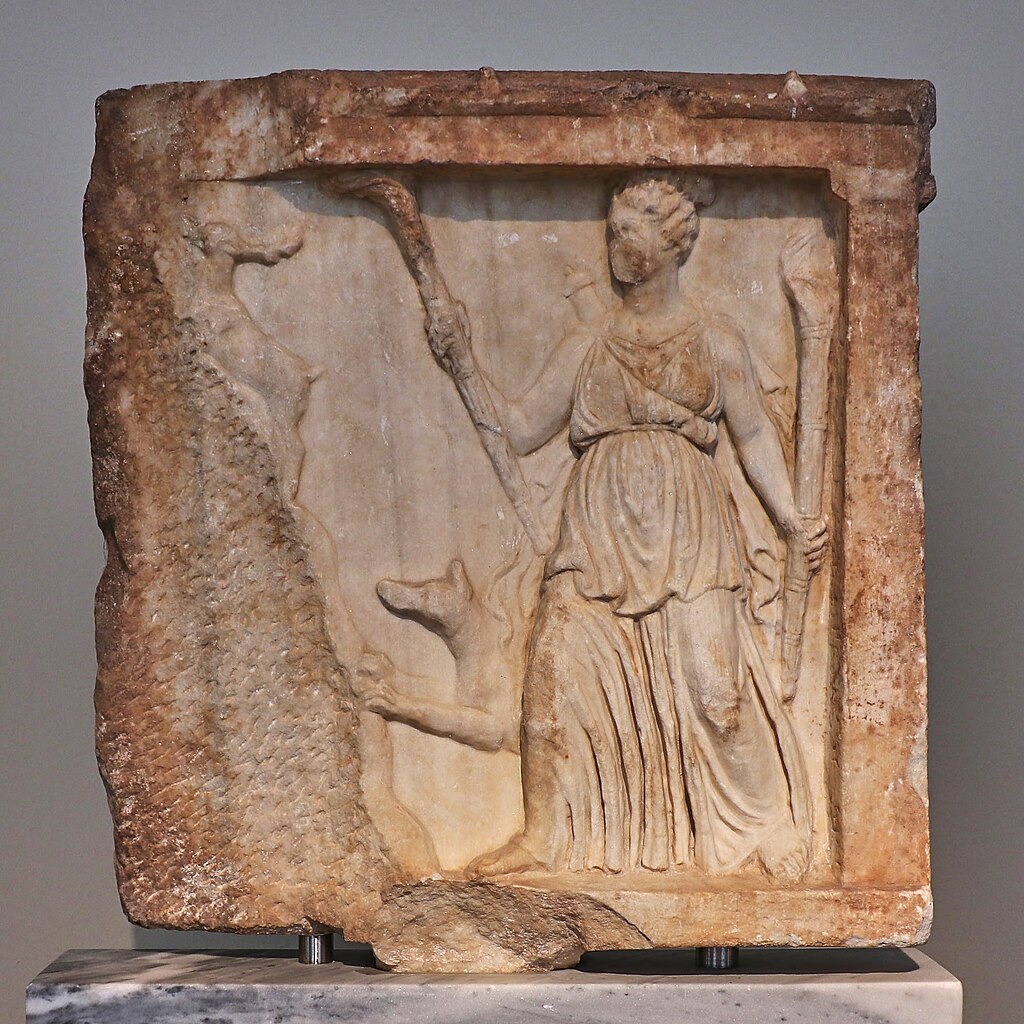
Artemis
Marble relief depicting Artemis holding two long torches and accompanied by a hunting dog. 4th century B.C., Megara.
Unlike Asclepius, whose divine function was limited to healing, Artemis was a multi-faceted goddess with a range of protective powers. Not only could she come to the aid of soldiers and armies, she was also invoked by travellers at sea and women at childbirth. She was also a guardian of gateways and entrances: armed images of Artemis carrying bows or torches facing outward could intercept dangers coming from without. While the goddess is frequently depicted as holding a single torch, images of Artemis holding two long torches are less common: her burning torches might be metaphorical of ‘light’ and the ‘saving’ she could bring.
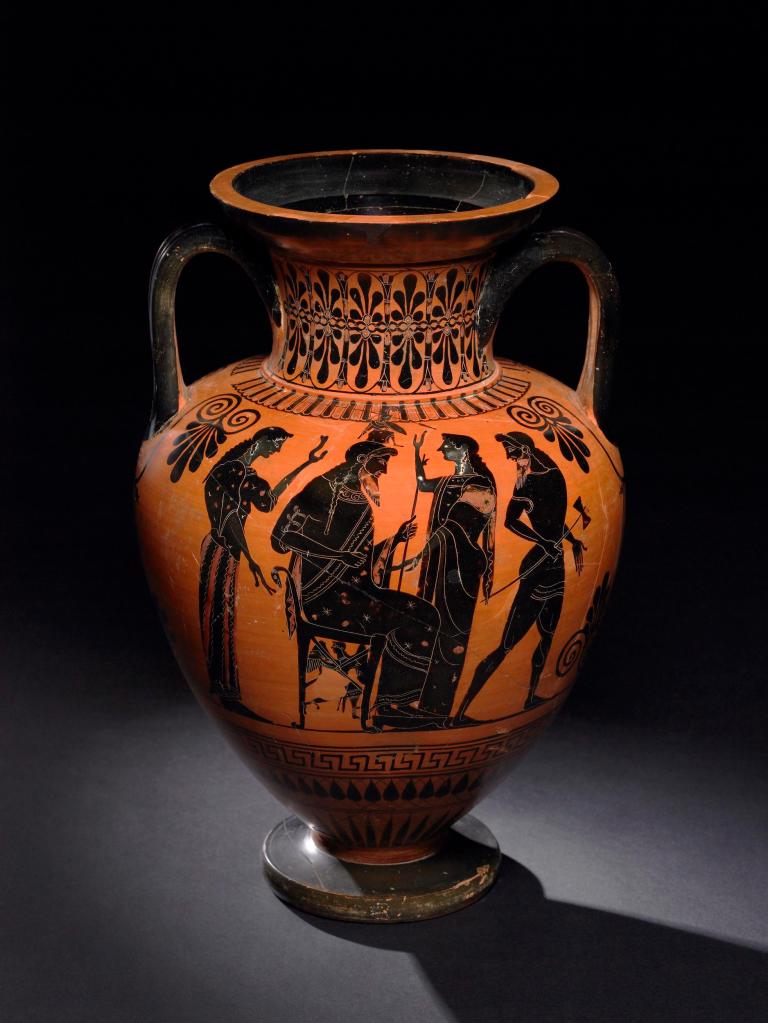
Athena
Birth of Athena depicted on a red-figure neck-amphora, c. 515 B.C., Vulci in Italy.
British Museum 1837,0609.27. Shared under a CC BY-NC-SA 4.0 licence.
According to mythology Zeus gave birth to Athena after swallowing Metis, and so Athena in some way embodied metis (‘cunning intelligence’). At birth she emerged from Zeus’ head fully armed, which is symbolic of her competence in warfare. Yet her powers were much more wide-ranging than this: she was skilled in different kinds of craft including weaving, carpentry, and metalworking, and she had the technological art of navigation, equestrian skills, and even (very occasionally) medicine. Her great power owes in part to her unique closeness to Zeus, which is emphasised by the myth of her birth depicted here.
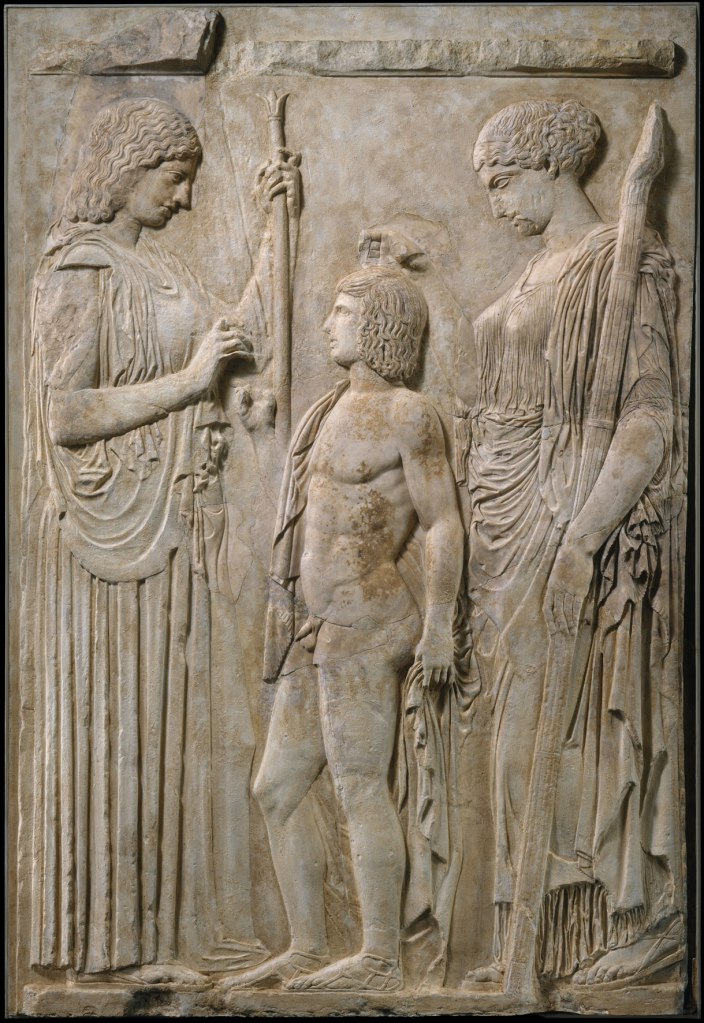
Demeter and Kore
Roman copy of the great Eleusinian relief, c. 27 B.C. to 14 A.D., Rome.
Metropolitan Museum 14.130.9. Rogers Fund, 1914. Open Access image.
Differently from some other gods who could actively intervene in the life of worshippers or deliver them from actual dangers, Demeter played a role in the welfare of the Greeks that was less readily noticeable but no less important. She blessed mankind with the gift of grain and oversaw the physical sustenance of the world, but could not grant immediate relief from agricultural hazards. The goddess (left) is holding a sceptre and her daughter Kore (right) holding a torch; they appear to be blessing Triptolemus (? middle), who was sent by Demeter to teach mankind the art of agriculture.
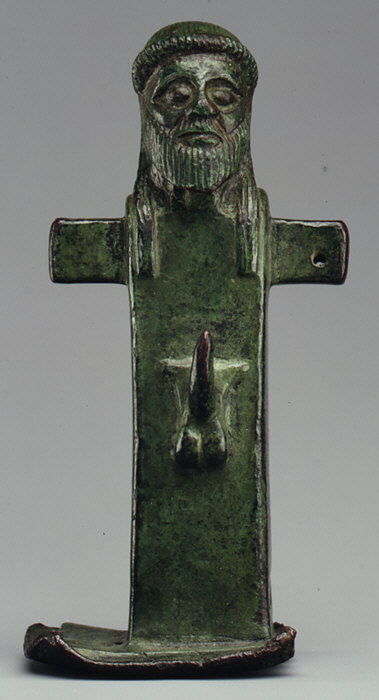
Hermes
Small bronze herm showing a bearded Hermes with an erect phallus. 5th century B.C., Arcadia.
Metropolitan Museum 1989.281.56. Gift of Norbert Schimmel Trust, 1989. Open Access image.
A herm was a rectangular pillar monument usually erected at boundaries, outside dwellings, at gates and entrances. It took its name from Hermes, who in Greek mythology was well-known as a divine trickster, a messenger of the gods, and an escort of souls to the underworld. Hermes was worshipped by the Greeks as a protector of flocks, travellers, merchants, and households. In a domestic context his image could be set up outside the threshold to guard against the transgression of boundaries and the intrusion of thieves. Here this miniature bronze herm of exceptionally fine quality is likely to have been a dedication to the god.
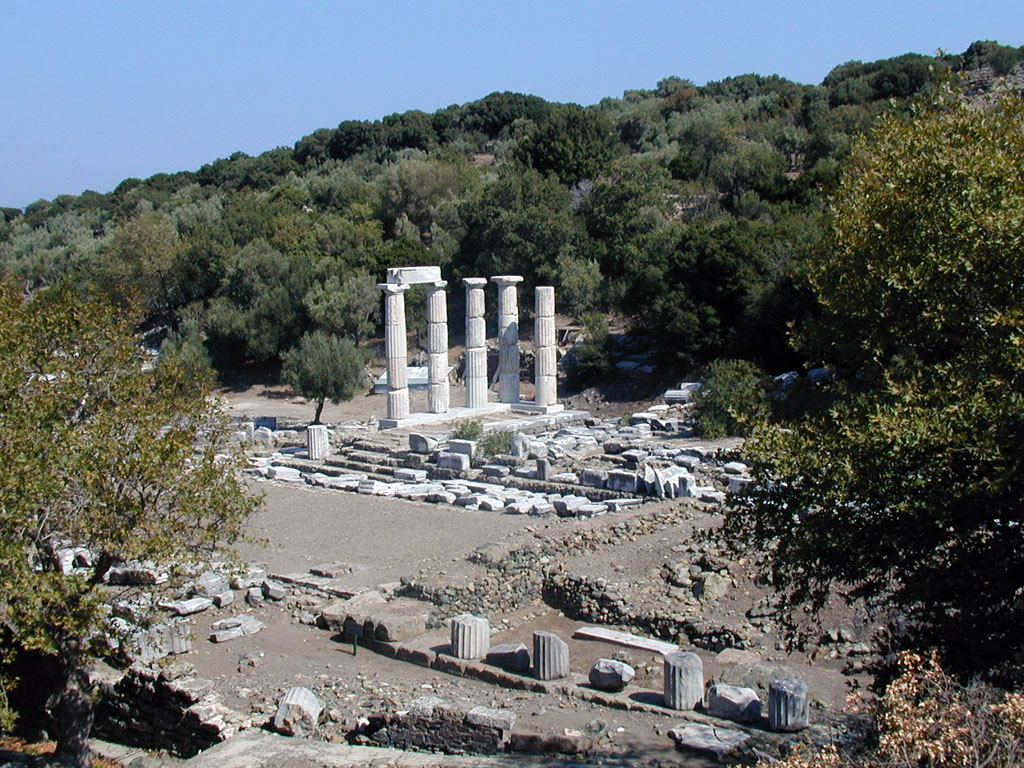
The Samothracian gods
The sanctuary of the Great Gods at Samothrace.
Photo by Marsyas (21 September 2001) via Wikimedia Commons, shared under a CC BY-SA 3.0 license.
The cult of the Great Gods (Theoi Megaloi) at Samothrace, situated in the northern Aegean Sea, was well-known for the maritime protection it offered. Those initiated into the Mysteries of the Great Gods at Samothrace were believed to have deliverance even if they should encounter dangers at sea. As specialist helpers of seafarers, the Samothracian gods were closely related in function to the Dioscuri. However, it is unclear how they actually came to worshippers’ rescue when invoked in tempests: their identity, iconographical representation, and mode of operation unfortunately all elude us.
 SAVING GODS.com

