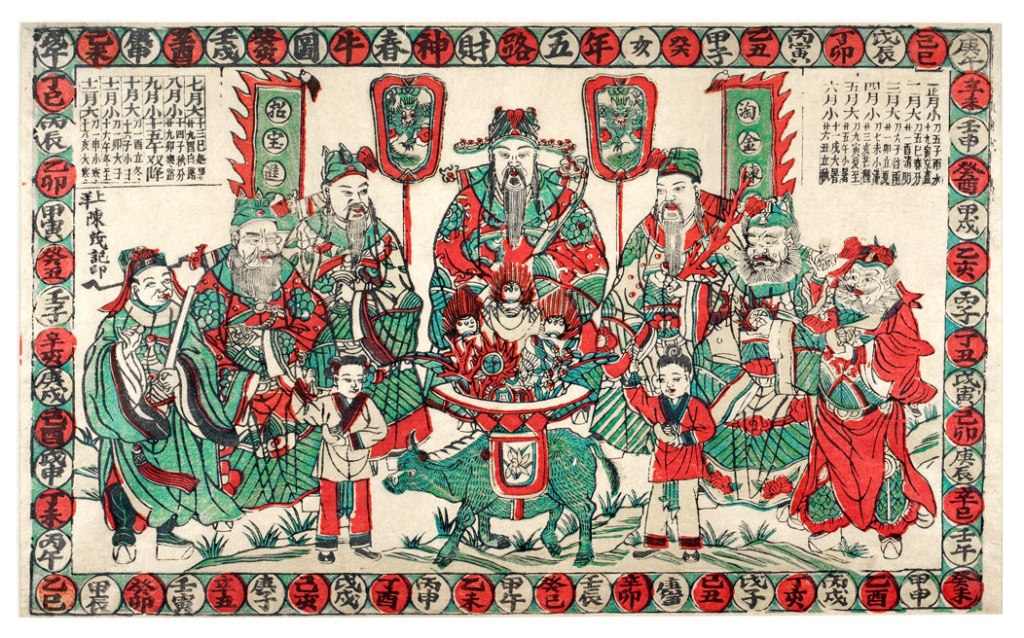
Prayers and vows, such as those presented in section two, convey the content of communication with gods. As for the techniques of such communication, there was a variety. Depending on the venue, it might involve visiting a god’s temple to say prayers, to request dreams, or to conduct divination. If gods were worshipped at home, they could be invoked to descend to the home altar, or, in the case of spirit-writing practiced ever since the twelfth century, to wield a writing tool and give messages. Most of these techniques were ritualized. Some complex rituals might need to be performed or guided by religious experts; other simpler rituals could be practised by the worshippers themselves.
These ritual techniques for communicating with gods flourished especially in southeast China in the second millennium. But before they emerged around the tenth century, communication with gods could easily become rough. Confrontation and explicit coercing seemed common. The first two stories below show vividly how such scenarios could occur when human needs were not met. The three texts that follow, in contrast, demonstrate a much more developed repertoire of techniques for communicating with gods.
4. 1 Confrontations
唐元和中,有陳鸞鳳者,海康人也。負氣義,不畏鬼神,鄉黨咸呼為後來周處。海康者,有雷公廟,邑人虔潔祭祀。禱祝既淫,妖妄亦作。邑人每歲聞新雷日,記某甲子。一旬復值斯日,百工不敢動作。犯者不信宿必震死,其應如響。時海康大旱,邑人禱而無應。鸞鳳大怒曰:「我之鄉,乃雷鄉也。為神不福,況受人奠酹如斯,稼穡既焦,陂池已涸,牲牢饗盡,焉用廟為。」遂秉炬爇之。其風俗,不得以黃魚彘肉相和食之,亦必震死。是日,鸞鳳持竹炭刀,於野田中,以所忌物相和啖之,將有所伺。果怪雲生,惡風起,迅雷急雨震之。鸞鳳乃以刃上揮,果中雷左股而斷。雷墮地,狀類熊猪,毛角,肉翼青色,手執短柄剛石斧,流血注然,雲雨盡滅。鸞鳳知雷無神,遂馳赴家,告其血屬曰:「吾斷雷之股矣,請觀之。」親愛愕駭,共往視之,果見雷折股而已。又持刀欲斷其頸,齧其肉。為群衆共執之曰。「霆是天上靈物,爾為下界庸人。輒害雷公,必我一鄉受禍。」衆捉衣袂。使鸞鳳奮擊不得。逡巡,復有雲雷。裹其傷者,和斷股而去。沛然雲雨,自午及酉,涸苗皆立矣。
Translated text: During the Yuanhe period (806-821) of the Tang dynasty, there was a man named Chen Luanfeng from Haikang.1 He was courageous and righteous, not afraid of ghosts or gods. All his village folks called him “the second Zhou Chu.”2 In Haikang, there was a Shrine of Thunder, to which the locals offered sacrifices piously with careful purification. As prayers grew excessively, evil spirits also started to emerge. Locals would record the day in a year when the first thunder sounded. For ten days, when it would be a day with the same heavenly branch,3 no tradesman would dare to operate. Those who violated [this taboo] would be killed by thunder overnight. Its efficacy never failed.
At the time there was a great drought in Haikang. Locals prayed but there was no response. Luanfeng said in fury: “My homeland is also the homeland of thunder. The god does not give blessings. It is even worse given that the god receives such sacrifices from the people. With the crops already burnt and the ponds already dried up, once the sacrificial animals are exhausted, what use will there be for the temple?” He then took a torch and burnt the temple down. According to local custom, one should not mix up yellow fish with pork. Those who ate a mixture of these would be struck to death by thunder. This day, Luanfeng went to the field with a knife made with bamboo charcoal. He made a mixture of the taboo foods, ate it, and waited for things to happen. Indeed, strange clouds and vicious winds arose. Rapid thunders and storms struck him. Luanfeng waved the blade upwards and cut off the left leg of Thunder, which then dropped to the ground. It looked like a wild pig, with furry horns and dark green fleshy wings. It held in its hands a short-handled axe made from hard stone and was bleeding heavily. Clouds and rains all stopped. Luanfeng realised that Thunder was no god.4 He then hurried home and told his family: “I cut a leg off Thunder. Come and see.” His kin were shocked and went together to examine it. They indeed saw Thunder with a broken leg. Luanfeng held up the knife again and was about to cut its neck and eat its flesh, but he was held back by the crowd. They said: “Lightning is a spirit from Heaven, but you are just a mortal from below. If you harm the Thunder God recklessly, disaster will surely fall on the whole village.” The crowd caught Luanfeng by the sleeves and stopped him from furiously attacking it. After a while, clouds and thunder emerged again to wrap up the hurt creature, pick up its cut leg, and left. It then rained amply from noon to dusk. Dried crops all stood up.
Source: ‘Chen Luanfeng’ 陳鸞鳳, Taiping guangji 太平廣記 (Extensive Records of the Taiping Era), compiled by Li Fang 李昉 (925-996), reprint Beijing: Zhuhua shuju, 1961, p. 3145-6.
4. 2 Coercing
淵濟公之號始於宋,其廟於兵亂間為金東莒公燕寧所毀,不數月而寧卒。歲在丙戌,元帥萊蕪劉璃權知泰安州事、守天勝,以久旱檮雨於龍池之側,時有小白蛇出戲於香鼎上,劉以為神龍所變,再拜祝之曰:三日之內有雨,則我將為神修廟。卜之吉,一軍歡呼羅拜。經數日無雨,劉怒曰:神許我雨,今既無雨,則無神矣。命諸隸卒揭西崖之石填其池,池將滿,雷雨暴至。如傾,雹大如鸚卵,眾惶怖驚走。既晴,視之,其池中所填之石悉為湍流衝去。
Translated text: The [god’s] title, Duke of Deep Ferry, was first awarded by the Song regime. The temple was destroyed during warfare by Yanning, the Duke of Eastern Lü5 of the Jin regime, who died within months afterwards. In the year of bingxu (1226), Marshal Liu Li from Laiwu came to govern Tai’an and guard the Tiansheng fortress. During a long period of drought, he went to pray for rain at the Dragon Pond.6 At the time, a little white snake came out to play on the incense burner. Liu thought it was a transformation of the divine dragon. He bowed twice and prayed: “If it rains in three days, I shall build a temple for the god.” The divination was positive. The whole army cheered and bowed with joy. Several days passed but there was no rain. Liu was infuriated. He said: “The god has promised me rain. Now since there is no rain, there must be no god.” He ordered his soldiers to cut rocks from the west cliff to fill up the pond. As the pond was about to be filled up, a thunderstorm suddenly came. In an instant, a hailstorm went so big as if it was dropping chicken eggs. The crowd was frightened and fled in panic. Once the sky cleared up, they went to the pond and found that all the rocks thrown in had been washed away by torrents.
Source: Wang Tianting 王天挺, ‘Wang Tianting ji’ 王天挺記 (Record by Wang Tianting), in Daishi II 岱史 下 (History of Mount Tai, chapter II), compiled by Cha Zhilong 查志隆 in 1699, reprint in Zhongguo daoguanzhi congkan xubian 中國道觀志叢刊續編 (Collections of Daoist Temple Records in China, Continued), vol. 6, p. 419.
4. 3 Dream request and spirit-writing
吴虎臣(曽)博聞強識,知名江西。為舉子日,謁夢於仰山,欲知科第遲速。其夜,夢紅袖女子執板而歌,覺而不能省憶,但記一句曰:「尋春不是探花郎。」是後竟不第,而以獻書得官。
吴奉紫姑神甚謹,每言事多驗。邑人吴仲權(鎰)將調官,請扣所向,箕箸既具,但畫龍與羊各數四。虎臣曰:「龍者,君象;羊者,仕塗禄料也。子必面君登朝矣。」仲權曰:「鎰乃一選人,名位甚卑,安得有此望。」虎臣曰:「曽以布衣,猶被召對,況於已在簪裳之列乎!神言有證,當不謬矣。」仲權私謂辰未年或可奮發,及赴部,乃注龍陽丞。
Translated text: Wu Huchen (Zeng) was a learned man in Jiangxi known for his extraordinary memory. When he was still a student preparing for the civil examinations, he once visited Mount Yangshan7 to request a dream about when he would get his degrees. That night, he dreamt of a young woman wearing red sleeves and singing to the beat of wooden clappers. When he woke up, he could not remember clearly except one sentence: “The one who seeks spring is not the one who finds flowers.”8 Later, he eventually failed the examinations, but instead obtained a position through the donation of books9 (to the court).
Wu served the Purple Maiden10 with great caution. The goddess’ predictions mostly proved to be true. Wu’s fellow countryman, Wu Zhongquan (named Shi), was about to be posted elsewhere. He asked to consult the goddess about where that would be. Once they prepared the writing board and stick, what they got from the spirit-writing were depictions of dragons and sheep, each about four in number. Huchen said, “The dragon is a symbol of the ruler, and the sheep means the rank and salary of an official. You will certainly have an audience with the emperor in the court.” Zhongquan replied: “I am only an examination candidate with humble rank. How can I expect that!” Huchen said: “I was only a commoner but was still summoned. Not to mention that you are already among the candidates for officials. The goddess’ words always come with proof. It should be the case.” Zhongquan reckoned that he might be able to thrive in the chenwei year (chen is the year of the dragon and wei is the year of the sheep, as depicted in the spirit-writing message). When he arrived at the Ministry (of Personnel), he was given the position of Deputy Magistrate of Longyang county (‘Long’ means dragon and ‘yang’ has the same sound as the character meaning sheep).
Source: ‘Wu Huchen mengbu’ 吴虎臣夢卜 (Wu Huchen has an oracular dream), in Hong Mai 洪邁 (1123-1202), Yijian zhi 夷堅志 (Record of the Listener) (reprint, Beijing 1981), zhi yi, 2.808.
4. 4 Casting moon blocks
撫州金溪縣。有神廟甚靈顯。所請者施金帛無虛日。積錢至二千緡。宗室善文過廟。心資其利。焚香禱曰。損有餘。補不足。人神一也。善文至貧。願神以二十萬見假。不然。將白于官。悉籍所有而焚廟。神雖怒。若我何。既禱即呼廟祝取錢。祝無辭以卻。但曰。神許則可。善文取杯珓擲之。連得吉卜。再拜謝。運鏹以出。
如是十年。夢神來謂曰。曩日所貸。今可償矣。夢中窘甚。約以緡(一作紙)錢還之。神不可。曰。此特虛名耳。又欲倍其數。亦不可。善文計窮。以情告曰。一時失計為人。今實無可償。願神哀釋。神沉思良久。曰。必無錢見歸。但誦金剛經。每卷可折一千。他無以為也。既覺而懼。遂遽齋戒。取經諷讀。凡三日得二百過。默禱以謝之。後不復夢。
Translated text: In Jinxi county of Fuzhou prefecture, there was a temple which was quite efficacious. Every day those who prayed to the god would make offerings of cash or silk. The temple had accumulated cash of up to two thousand strings of coins.11 Zhao Shanwen, a member of the imperial clan, came to visit the temple and coveted its profit. He burnt incense and prayed: “[Wealth] should be taken from the affluent and given to the poor. In this regard, humans and gods are the same. Now I am extremely impoverished. May the god lend me two hundred strings of coins. Otherwise, I shall report to the authority, who will then confiscate all the wealth and burn the temple. Even though the god will be angry with me, what can you do?” Having finished his prayer, Zhao immediately asked the temple carer to bring the money. Having no excuse to refuse him, the temple carer merely said: “You can do it only if the god allows you to.” Shanwen then took a pair of moon blocks and threw them to divine. He got a succession of positive results. Bowing twice with thanks, he carried out the money in silver ingots.
Ten years later, Zhao dreamt of the god coming to tell him, “What I have lent you in the past, now it is time to pay me back.” Zhao was very embarrassed in his dream and promised to pay back in spirit money.12 The god disapproved, saying: “Those are just empty things.” Zhao then offered to double the amount. The god disapproved again. Having exhausted his tricks, Zhao told the truth and pleaded that he had once lost his livelihood and decency. At the time, he in fact did not have anything to repay with. He pleaded with the god to show pity and forgive him. The god thought for a long while and said, “If you really don’t have the money to pay me back, just incant the Diamond Sutra.13 Each finished scroll will offset a thousand coins. There will be no use doing anything else.” Once Zhao woke up, he felt frightened. He immediately fasted and started to incantate the sutra. In three days, he completed two hundred incantations in total. He silently prayed to thank the god and never dreamt about it again afterwards.
Source: ‘Zhao Shanwen’ 趙善文, in Hong Mai 洪邁 (1123-1202), Yijian zhi 夷堅志 (Record of the Listener) (reprint, Beijing 1981), jia, 5.43.
4. 5 Daoist rituals
魏道弼參政夫人趙氏。紹興二十一年十月十六日以病亡。至四七日。女婿胡長文元質延洞真法師黃在中。設九幽醮。影響所接。報應殊偉。魏公敬異之。及五七日。復命主黃籙醮。先三日。招魂入浴。幼子叔介。年十二歲。以念母之切。願自入室持幡伺視。既入,慟哭云。母自白幡下坐椅上。垂足入浴。盆左右掛所著衣。正舉首相顧。忽焉不見。所以哀泣。
已而迎魂至東偏靈位。黃師見夫人在坐。叔介至前即僕地。曰。媽媽在此。家婢小奴。先因病腫死。亦從而至。語言甚久。黃慮鬼氣傷兒神。乃布氣吹其面。取湯一杯。令飲即醒。云適往市門下看迎仙女。見數十人衣金錦袍。擁一轎。四角皆金鳳。口銜金絲毬。二仙童行前。捧金香爐唾壺。到吾家門。仙女出轎。見先生再拜請符。才得符。收置袖間。卻乘金毛羚羊。二童導而去。遂覺。蓋所見者。乃是夕壇上所供神虎堂追召魂魄者也。
時已五鼓。方就睡。又夢入大門。將軍長丈許。金甲青鞾。引而行。殿上人服青服。戴青冠。執青圭。坐龍椅上。云太一救苦天尊也。聞呼第二曹請九天司命第□主者同坐。俄空中青雲起。玉女數百。捧紅幡幢。迎上清宮第六位至。共食仙果。叔介前觀之。為異鬼如師子形者逼逐令去。將軍叱曰。救苦天尊請來對罪。安得輒逐。命獄卒碎斫之。左右天仙無數。嬉戲自如。或戴碎玉花冠。動搖有聲。(…)
Translated text: Lady Zhao, the wife of Vice Grand Councillor Wei Daobi, died of disease on the sixteenth day of the tenth month of the twenty-first year of the Shaoxing period (1151). On the final day of the Fourth Seven-day period,14 her son-in-law Hu Changwen, courtesy name Yuanzhi, invited the Ritual Master15 of Cavern Transcendent, Huang Zaizhong, to hold an Offering of the Nine Mysteries.16 The responses from the ritual were especially good, and the Honourable Wei marvelled at it in awe. When it came to the final day of the Fifth Seven-day period, they again asked the ritual master to preside over an Offering of the Yellow Register. In the first three days, the deceased’s soul was summoned to take a bath. Her youngest son Shujie was twelve years old. Missing his mother intensely, he asked to go into the room alone to hold the banner and wait on her. Once he entered the room, he cried in great sorrow and said, “Mother came down from the white banner and sat on the chair. She lowered her feet into the bath. On both sides of the bath tab hung clothes she wore. As I looked up to her, she suddenly disappeared, hence I cried in sorrow.”
Later, her soul was led to the spirit tablet on the east side. Master Huang saw the Lady seated there. Shujie came over but soon fell to the ground, crying: “Mama is here! The young maid who had previously died of disease also followed her here.” He talked for quite a while. Master Huang worried that the ghostly qi would harm the child, so he gathered a breath and blew it onto his face. He also got a cup of hot water and asked the child to drink it. Soon the child came back to himself and said: “Just now I went to the city gate to watch people welcoming the Immortal Lady. I saw more than ten people dressed in golden embroidered gowns gathering around a sedan-chair, on the four corners of which stand golden phoenixes, each holding a golden thread ball in its beak. Two immortal lads walked in front, holding a golden incense burner and a spitting-pot. They arrived at our house. The Immortal Lady came out of the sedan-chair. Upon meeting the master, she bowed twice and asked for a talisman. After receiving the talisman and tucking it into her sleeves, she rode on a goat of golden fleece and was led away by the two lads. I then woke up.” What the child had seen was in fact the soul-summoner from the Hall of the Divine Tiger, who was worshipped on the altar that night.
At the time it was almost dawn. Just as the child fell asleep, he started dreaming again of entering a great gate, led by a general who was over one zhang tall (about 3.3 metres) and was wearing golden armour and dark boots. Someone in the hall was dressed in dark clothes, wearing a dark headdress, holding a dark jade tablet, and seated in a dragon chair. He was the Heavenly Worthy of Great Unity Who Saves from Suffering.17 The child heard him calling the second department18 to invite the Administrator of Fate from the Ninth Heaven, who was the [XX]th administrator, to go and sit together. Shortly, dark clouds gathered in the sky. Hundreds of jade ladies holding red banners welcomed the arrival of the sixth (immortal) from the Palace of Supreme Purity. As they were having immortal fruits together, Shujie went forward and watched. But he was chased away by a strange ghost in the appearance of a lion. The general shouted at the ghost: “The child was invited by the Heavenly Worthy Saving from Suffering to come and give testimony. How dare you chase him away without approval!” He commanded the prison guards to slash the ghost into pieces. Around them there were numerous heavenly immortals, playing merrily and freely. Some of them wore flower wreaths with jade pieces, making sounds with each movement. (…)
Source: ‘Huang fashi jiao’ 黃法師醮 (Offerings by Ritual Master Huang), in Hong Mai 洪邁 (1123-1202), Yijian zhi 夷堅志 (Record of the Listener) (reprint, Beijing 1981), bing, 10.448-51.
Notes:
- Haikang: present-day Leizhou on the far south tip of Guangdong province; with a climate of frequent tropical thunderstorms, its present name may reflect the tradition of worshipping Thunder Gods. ↩︎
- Zhou Chu: dated 236-297 AD, a chief minister of the Western Jin dynasty (266-316) known for killing monsters when he was a young man. ↩︎
- a day with the same heavenly branch: days were marked with the sexagenary cycle known as the stems-and-branches system. ↩︎
- Thunder was no god: may also mean thunder having no divine power. ↩︎
- Duke of Eastern Lü: (d. 1221) a nobleman under the Jurchen regime, which ruled north China during the 12th and 13th centuries. ↩︎
- Dragon Pond: dragons were believed to live in mountains or deep ponds with the power of bringing rain. ↩︎
- Mount Yangshan: a sacred site in west Jiangxi, south China, where the temple to the mountain gods was located. ↩︎
- the one who finds flowers: alluding to the third place in the final examination held at the imperial palace. ↩︎
- donation of books: a reward scheme usually implemented by the imperial state after a period of war to gather surviving manuscripts for the imperial library. ↩︎
- the Purple Maiden: a popular goddess of spirit-writing known for her literary skills. ↩︎
- string of coins: 1,000 coins strung together. ↩︎
- spirit money: currency for use in the underworld. ↩︎
- the Diamond Sutra: one of the major sutras in Chinese Buddhism, the chanting or copying of which was believed to be able to invoke divine power. ↩︎
- Seven-day period: the 49 days after a person’s death divided into seven seven-day periods in Daoist funeral rituals, with specific rituals to be performed on the last day of each period. ↩︎
- Ritual Master: usually referring to a Daoist priest or a specialist exorcist. ↩︎
- Offering of the Nine Mysteries, Offering of the Yellow Register: both are Daoist rituals for redeeming the souls of the dead from the underworld. ↩︎
- Heavenly Worthy of Great Unity Who Saves from Suffering: a Daoist saviour god popular since around the tenth century. ↩︎
- the second department: the Daoist underworld was administered by a bureaucracy of ministries, departments, and offices similar to those of the human world. ↩︎
 SAVING GODS.com