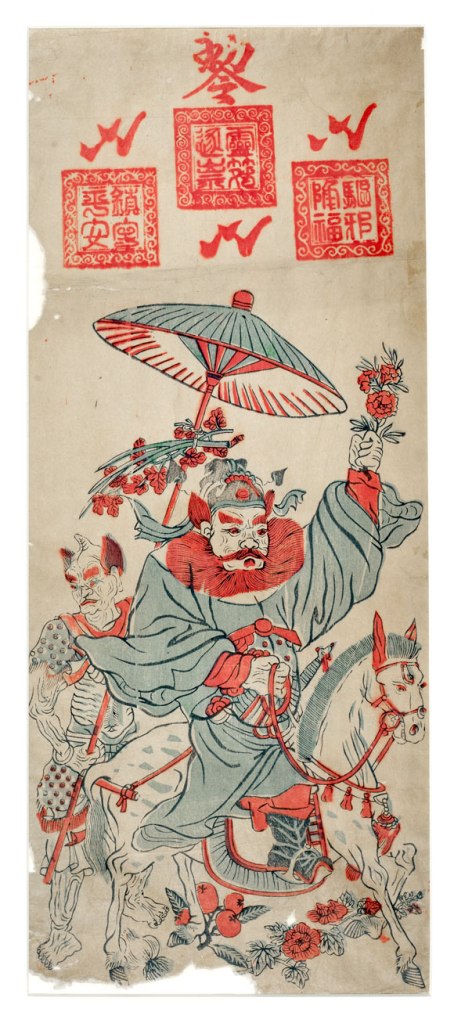
The relationship between humans and Chinese gods seems to be a two-way process. Gods might cope with humans by giving punishments or blessings. For humans, a large part of coping with the gods was to maintain good terms with them and motivate them to give blessings continuously. The Chinese imperial state applied its bureaucratic system to the divine world and developed a reward system of ranks and titles (5.1). Under it, the state gave titles to the gods and their temples upon requests from local administrations. For some powerful gods, not only titles were awarded to the gods themselves, but also to their family members, subordinates, assistants, and close associates (5.2, 5.3).
Coping with gods also involved regulations and punishments. For example, the Daoist exorcist tradition had developed rules to restrain and discourage gods and spirits from wrongdoing. A spirit code from the twelfth century categorised various cases of offences and specified the penalties for each type (5.4). The imperial state also devised regulations over the award of divine titles and had the right to rebuke the titles of gods who failed their duties (5.5). In extreme cases, gods could be demoted or demolished for slackening duties or causing harm to humans. Through the mechanism of rewards and penalties, humans were essentially harnessing the divine world.
5. 1 Rules on giving titles
神宗熙寧七年十一月二十五日,詔:「應天下祠廟祈禱靈驗,未有爵號者,並以名聞,當議特加禮命。內雖有爵號,而褒崇未稱者,亦具以聞。」
徽宗政和元年七月二十七日,詔:「太常寺、禮部遍行取索,纂類祀典。將已賜額並曾封號者作一等;功烈顯著,見無封額者作一等;民俗所建,別無功德及物,在法所謂淫祠者作一等。各條具申尚書省,參詳可否取旨。」
Translated text: On the twenty-fifth day of the eleventh month in the seventh year of the Xining period (1074), Emperor Shenzong issued an edict: “For shrines and temples across the empire which have shown miracles and efficacy to prayers but do not have any ranks or titles, their names should be made known to the court, which will then discuss special appointments with ceremonies. Among them, those which already have ranks and titles, but the honours do not match their status, should also be made known.”
On the twenty-seventh day of the seventh month in the first year of the Zhenghe period (1111), Emperor Huizong issued an edict: ‘The Court of Imperial Sacrifices and the Ministry of Rites1 are to gather all possible materials to compile a categorised code of sacrifice.2 They should register as one type those temples which have already been awarded plaques and titles; as another type those temples which have manifested merits and efficacy but have not yet been conferred any plaques; and as yet another type those temples which were established by custom but have not shown any merits or virtues for the people and thus should be regarded as illicit shrines3 according to rules. Each of those cases should be reported in detail to the Department of State Affairs, which then will examine their eligibility and seek a final decision from the emperor.
Source: Song huiyao 宋會要 (Collection of Important Official Documents of the Song Dynasty), collated by Xu Song 徐松 (1781-1848), reprint, Beijing, 1935, ‘Li’ 禮, 20.2b, 20.10a.
5. 2 Giving new titles to a god
加封 忠祐靈濟昭烈王(妃,一公,四侯,皆加封;趙,柳二夫人初封) 紹興二年四月十三日,誥詞云:當其危急以投誠,乃赫威靈而響應,具陳顯跡,敢後褒崇。(按《顯應集》:紹興元年,高彥,張琪前後入境,百姓祈哀,賊兵敗走。)
加封 正順忠祐靈濟昭烈王(妃,夫人,一公,四侯,並加封) 紹興五年十二月二十九日,以六月内詔 “訪聞諸路,久愆雨澤,委守令於境内靈應去處精加祈禱”,本軍詣廟齋醮,即日得雨,境内霑足。太守湯鵬擧奏聞,加封。
Translated text: To award a higher title:4 The King of Loyal Protection, Efficacious Assistance, and Bright Martyrdom ([The god’s wife] the Consort, [his sons] one Duke, and four Marquesses are all awarded higher titles. [The god’s concubines] the two Ladies of Zhao and Liu are awarded their first titles.) Awarded on the thirteenth day of the fourth month of the second year of the Shaoxing period (1132). The imperial order reads: When people prayed with sincerity during crisis and urgency, [the god] showed great power and efficacy in responding [to their requests]. Given the manifest traces as reported in detail, how can any rewards and honours [for the god] be delayed! (According to the Collections of Manifestations and Responses: in the first year of the Shaoxing period, the rebels Gao Yan and Zhang Qi entered the area one after another. People prayed to the god in sorrow and the rebels fled in defeat.)
To award a higher title: The King of Righteous Obedience, Loyal Protection, Efficacious Assistance, and Bright Martyrdom (The Consort, the Ladies, one Duke, and four Marquesses are all awarded higher titles.) Awarded on the twenty-ninth day of the twelfth month of the fifth year of the Shaoxing period (1135). In the sixth month, the emperor ordered that: “It was made known to me that many prefectures have had no rain for long. I therefore commission the prefects to visit sites of gods in their area5 that show efficacy and responses and to pray with piety and caution.” The administrators of our military prefecture visited the [god’s] temple and performed rituals of offering. On the same day it rained and the whole area was amply wet. Prefect Tang Pengju reported [the god’s efficacy] to the court,6 hence a higher title was awarded.
Source: ‘Jiafeng, gaifeng’ 加封, 改封 (Higher titles; Change of titles), Cishan zhi 祠山志 (Records of the Mount of Cults), first compiled by Zhou Bingxiu 周秉綉 during the Yuan period, then expanded by Zhou Xianjing 周憲敬 in 1886, reprint in Zhongguo daoguanzhi congkan xubian 中國道觀志叢刊續編 (Collections of Daoist Temple Records in China, Continued), vol. 8, p. 121-126.
5. 3 Giving new titles to a goddess
宋光宗紹熙元年,加封「靈惠妃」詔:奉天承運皇帝詔曰:古今崇祀岳瀆,懷柔百神,禮所不廢;至於有功國家、有裨民社者,報當異數。靈慈福利夫人林氏,靈明丕著,惠澤亶敷,累有御災捍患之勛,今見救旱恤民之德,參贊既弘,爵寵應尊。茲特進封為「靈惠妃」。秩視海岳之崇,典敘春秋之重。尚其服茲徽命,以懋鴻庥於勿替。欽哉!
慶元六年,朝廷以神妃護國庇民,功參玄造,人本乎親,慶自先貽,於是頒詔封妃父為「楨慶侯」,又改封「威靈侯」,又以顯赫有裨民社,加封為「靈感嘉佑侯」;母王氏封「顯慶夫人」;兄封「靈應仙官」;神姊封為「慈惠夫人」。
Translated text: In the first year of the Shaoxi reign of Emperor Guangzong in the [Southern] Song (1190), the court issued an edict to confer a higher title,7 the ‘Consort of Efficacy and Favour’:8 The emperor who serves Heaven and continues the state’s fortune has issued an edict: “[Dynasties] past and present offered sacrifices to mountains and rivers and appeased the hundreds of gods; these rituals would always be practiced. For gods who have shown merits to the state and assisted the people, the rewards should be especially generous. Lady Lin of Efficacy, Kindness, Bliss, and Benefit has been extremely efficacious and has given widespread favour. In the past, the goddess had many merits in defending the state from disasters and misfortunes. Now she has shown virtue in relieving droughts and saving the people. Her mediative role [between Heaven and human] has been significant; her title and honour should also be noble. I hereby advance her title to the ‘Consort of Efficacy and Favour.’ The rank shares the loftiness of those of the seas and mountains; and the code of rituals records the significance of the sacrifices held in spring and autumn.9 May the goddess commit herself to this magnificent conferment and expand her grand blessings forever. With respect!
In the sixth year of the Qingyuan reign (1200), the court determined that the Divine Consort protected the state and its people; her merits are comparable to those of the mysterious Creator. As people originate from their parents, the celebration of their achievements should also be traced back to their ancestors. The court therefore issued edicts to award the Consort’s father the title ‘Marquess of Vigour and Celebrations’, then changed it into ‘Marquess of Awe and Efficacy;’ later considering his grand status, which was beneficial to the people and the land, it advanced his title to the ‘Marquess of Efficacious Resonance and Auspicious Assistance’. The court also conferred titles to the Consort’s mother, surnamed Wang, as the ‘Lady of Illustrious Celebrations’; the Consort’s older brother as the ‘Immortal Officer of Efficacious Response’; and the Consort’s older sister as the ‘Lady of Kindness and Favour.’
Source: Records of the Heavenly Consort Manifesting Divine Power 天妃顯聖錄, first compiled around the 1620s by Lin Yaoyu 林堯俞, reprint in Taiwan wenxian congkan 台灣文獻叢刊 (Collection of Documents in Taiwan), Taibei, 1960, vol. 77, p. 3, 59.
5. 4 Daoist penal codes
諸當職之神,輒與民人婦女私通者,流三千里。情理重者,奏裁。如地分鬼神犯者,加一等。諸鬼神無故害人性命及偷盜人間財物,不受咨懇被捉者,處死。所屬城隍土地等故縱者,同罪。失覺察者,杖一百。
諸蝗蟲旱潦天霜雪雹害民稼穡,本地分神衆不能救濟,驅邪院差將吏同力止絕,違者,杖一百。事干天曹時行年灾,許具章表奏聞。
諸稱水者,不以大小淺深,善能滋養稼穡而不隨時者,許九江水帝察其功過保奏,違者杖一百。
諸龍神鬼主江河汙流去處,若故曲邀舟車祭祀者,徒二年。妄興風雨,翻陷田屋至傷人命,一人流三千里,十人處死,十人已上滅形。干涉湖潭主守,並同罪。本地分不紏者,罪亦如之。
Translated text: Any gods on duty committing random adultery with common people’s wives shall be exiled to a distance of three thousand li.10 Serious cases shall be reported to Heaven for decision. If the perpetrators are gods or spirits administering the place, an extra level of penalty shall be added. Any spirits who harm people’s lives for no reason, steal properties of the human world, and who are captured for refusing to be investigated, shall be executed. City gods and earth gods who administer the area but give free reign to the perpetrators shall be convicted with the same crime. Those who fail to notice the crime shall be beaten a hundred strokes with the heavy rod.
In various cases of locusts, drought and flooding, frost and hailstorm which harm crops, when local gods are unable to save [the people], the Court of Exorcism11 will dispatch officers and clerks to join their effort. Those who disobey [the dispatchment] shall be beaten a hundred strokes with the heavy rod. For cases involving the Heavenly Administration implementing seasonal disasters, they are allowed to report the matter in a memorial.
Any gods or spirits named after rivers, regardless of whether big or small, deep or shallow, if they are benevolent and can nurture crops outside the seasons, allow the Emperor of Waters Who Oversees the Nine Rivers to investigate their merits and violations for reporting to the court. Those who disobey shall be beaten one hundred strokes with the heavy rod.
Any dragon gods and spirits who are in charge of places along rivers and stream, if they harass passenger ships and carriages to request sacrifices, they shall be given two years’ penal servitude. Those who start wind and rain without authorization, blow over houses or cause flooding, and as a result harm lives, for one human life they shall be exiled to a distance of three thousand li. For ten lives, they shall be executed. Above ten lives, they shall be annihilated. Those administrators of lakes and pools related to the incident shall be punished for the same crime. Those who administer the local area but do not look after the case shall also be punished for the same crime.
Source: Shangqing gusui lingwen guilü 上清骨髓靈文鬼律 (Spirit Code in Numinous Script from the Marrow of Supreme Purity), compiled by Rao Dongtian 饒洞天 (tenth century), Deng Yougong 鄧有功 (1210-1279), reprint in the Daoist Canon 道藏 of 1445 (no. 203), 1.3b-4a, 7a-b.
For more entries from the Code, see Appendix 2.
5. 5 Abolishing ‘unresponsive’ gods
大小青龍神者,記云:「有僧名盧,寓西山。有二童子來侍。時久旱,童子入潭化二青龍,遂得雨。後賜盧號曰感應禪師,建寺設像,別設龍祠於潭上。宣德中,建大圓通寺,加二龍封號,春秋祭之。」邇者連旱,祈禱無應,不足崇奉明矣。
崇恩真君、隆恩真君者,道家以崇恩姓薩名堅,西蜀人,宋徽宗時嘗從王侍宸、林靈素輩學法有驗。隆恩,則玉樞火府天將王靈官也,又嘗從薩傳符法。永樂中,以道士周思得能傳靈官法,乃於禁城之西建天將廟及祖師殿。宣德中,改大德觀,封二真君。成化初改顯靈宮。每年換袍服,所費不訾。近今祈禱無應,亦當罷免。
Translated text: About two Dragon Gods,12 the great one and the minor one, records have it that: “Once there was a monk named Lu who lived in the West Mountain. Two young boys came to serve him. During a drought that lasted long, the boys entered a deep pool and transformed into two blue dragons. Then rain started. Lu was later awarded the title ‘Chan Master of Sympathetic Responses’. People built a temple for him and established his statue. A Dragon Shrine was built separately beside the deep pool. During the Xuande reign (1426-1435), the Temple of Great Thoroughness was built [on the same site], and the two dragons were awarded titles. People offered them sacrifices during spring and autumn.” Recently, the drought has continued for a long time and [the Dragon Gods] have not responded to prayers. They obviously do not deserve the worship.
About the Transcendent Lords13 of Lofty Favour and Abundant Favour, Daoists claim that Lofty Favour was named Sa [Shou]jian from the west of the Shu region. During emperor Huizong’s reign (1100-1125) in the Song, he once learned Daoist methods from Wang Shichen and Lin Lingsu14 and showed efficacy. As for the Transcendent Lord of Abundant Favour, he was in fact the Numinous Officer Wang Who Is a Heavenly Commander from the Jade Pivot and Fire Mansion. He once studied talismanic methods15 from Sa. During the Yongle period (1403-1424), a Daoist priest Zhou Side was known to transmit the methods of Numinous Officer Wang. A Temple of Heavenly Commander and a Hall of Patriarchs were therefore built to the west of the Forbidden City. During the Xuande reign (1426-1435), they were named the Temple of Great Virtue. Sa and Numinous Officer Wang were also made Transcendent Lords. In the early years of the Chenghua reign (1465-1487), the temple was named the Palace of Manifest Efficacy. Each year it incurred huge cost in changing [the gods’] robes and clothes. Nowadays there have been no responses to prayers. These gods should also be abolished.
Source: Ming shi 明史 (History of the Ming Dynasty), compiled by Zhang Tingyu 张廷玉 (1672-1755), modern edition, Beijing 1974, ‘Li’ 禮, 50.1308, 1309.
Notes:
- Court of Imperial Sacrifices and the Ministry of Rites: two administrations in charge of matters related to ceremonies, titles, and sacrifices, with the Court of Imperial Sacrifices usually being subordinate to the Ministry of Rites. ↩︎
- code of sacrifice: an official document presumably listing which gods local administrations should offer regular sacrifices to. ↩︎
- illicit shrines: temples that were determined as illegitimate, and sometimes demolished, by the central government. ↩︎
- to award a higher title: in this case by adding characters to the god’s current title, usually two characters at a time until reaching a total of eight. ↩︎
- in their area: local administrators had the obligation to offer sacrifices to registered local gods and to invoke them during natural disasters. ↩︎
- report to the court: a step in the procedures of title-awarding, a system that was developed during the Tang dynasty (618-908) and was brought into full play in the twelfth century. ↩︎
- confer a higher title: the Chinese imperial state maintained a system of ranks and titles for gods, who could obtain higher titles by showing efficacy. ↩︎
- Consort of Efficacy and Favour: in this title, the word ‘consort’ indicates the major rank, whereas the two words of ‘efficacy’ and ‘favour’ describe the main characteristics of her power; the number of characters in the title indicates the level within a particular rank. ↩︎
- spring and autumn: the two seasons of a year when regular annual sacrifices were held, synchronous with the sowing and harvesting activities of an agricultural society. ↩︎
- exiled to a distance of three thousand li, strokes with the heavy rod, and penal servitude: terms of penalty borrowed from the justice system of this world. ↩︎
- Court of Exorcism: the main department of law enforcement for the underworld in Daoist exorcism. ↩︎
- Dragon Gods: usually residing in mountains and having the power of giving rain. ↩︎
- Transcendent Lord: a title for Daoist gods or immortals. ↩︎
- Wang Shichen (Wenqing) and Lin Lingsu: two Daoist priests serving the Northern Song Emperor Huizong and known for their exorcist techniques. ↩︎
- talismanic methods: exorcist techniques practiced mainly by Daoist priests of the school known as Orthodox Unity. ↩︎

